
Showing posts with label ohio. Show all posts
Showing posts with label ohio. Show all posts
Heart of Ohio Trail
Heart of Ohio Trail

So how do you like my beard? Ive been growing it all season and now is the time to get out and let her flow in the breeze!
Like most of North America weve been experiencing some wild swings of weather here in the Ohio valley. After a string of hot summer like days and plenty of rain the temperature dropped like a rock Sunday night into Monday. I planned on riding today because the forecast called for cloudy skies but it wasnt supposed to rain. The temperature was a crisp 49 degrees F when I left the house this morning.
Its a little strange here it is June 1st and I have to gather up my winter tights, fleece jacket and wool hat with ear protection just to go for a bike ride. With my gear packed I headed to Mt. Vernon, Ohio to catch the Heart of Ohio Trail which is a rail trail I discovered last fall and have only ridden once so far.
The roughly 15 mile run one way is the perfect sized trail for a mid day ride through the Scenic central Ohio countryside. I discovered a few new interesting things on this ride I wanted to share on the blog.

No sooner had I got started down the trail I passed this giant smokestack I first photographed last year. The big difference now is the curious spiral staircase under construction. As I was standing there looking on an older gentleman pulled up on a recumbent trike so we struck up a conversation and I asked him about the project. Being from the area he said he saw an artists rendition of the finished construction which will twist its way about three-quarters of the way to the top and end in a 360 degree observation deck. The project is scheduled for completion by the 4th of July.

I will most certainly be making a return trip later this summer to check that out!

I decided to ride the Titanium General Purpose Bike on this ride. Ive been logging about 32 miles a week commuting on the Ti GP and loving it. The recent improvements in the handlebar and seat department have breathed new life into the bike and I find myself reaching for it often.
The bike trail shares the river valley with a state route. Along most of the passage the view of the highway is blocked by trees and vegetation. Occasionally the trail and the roadway are close enough that properties adjacent the road become visible for a few short stretches. From one of these openings I spotted this old tractor sitting at the front of a farm with for sale sign posted.

I love old fashioned stuff and history so of course I had to stop and check it out. The Farmall Cub was the smallest tractor built by International Harvester between the years of 1947 and 1981. During those years over 245,000 Cubs were made. This one is unique in that it looks like it has the original mowing set-up complete with three-blade mower deck and turf tires.

The Farmalls are my favorite of the antique tractors but I do love to look at them all. I dont know much about the details and have no idea of this models age but it does look it came from the 1950s or 60s. Oh yes one day I will have one of these of my own to tinker with.

Back on the trail I caught a glimpse of a structure through the woods off to my left away from the state route. Right away I spotted text like old signage. Suddenly like staring at a word search my mind connected the dots. Although most of the elements are obscured by brush I realized I was looking at another old Mail Pouch Tobacco ad.

In order to get a picture I had to park my bike and wade through wet chest high weeds to get close enough. The structure is open on the other side and was probably used as a livestock shelter. The building sits on the edge of a neglected pasture and now houses only some old tires and lumber.

To see my other photographs of Mail Pouch Barns click the label at the end of the post.
--
At the end of the trail I arrived in the small town of Centerburg, Ohio which got the name as it lies at the geographic center of Ohio. In its earliest days Centerburg was a stagecoach stop and later a railroad town. Once a rural passenger stop of the Cleveland, Akron and Columbus railroad during the peak of passenger rail in early America now visitors roll into town using the same right of way but today theyre moved by pedal power and not steam.

Centerburg looks like many small sleepy towns that time seem to have left behind.

I like the old Frigidaire sign hanging proudly along main street.

This brick residential street is no trendy urban revitalization. These pavers have probably been here for a hundred years. It amazes me how long a brick paved avenue lasts with nothing more than slight cupping where the wheels pass. Give a modern asphalt street about five years of freeze-thaw cycles and itll be reduced to a pot-holed mine field. I think we should have never got away from brick for residential and downtown city center streets.

A quaint Christian church built in 1911.

No, that handsome gent at the opening of this post is not me. Its General Daniel Harris Reynolds, C.S.A.
"A decendent of Knox Countys earliest pioneers, Confederate Brigadier General Daniel Harris Reynolds was born just three miles west of Centerburg in 1832. He attended Ohio Wesleyan University in Deleware, where he became a close friend of Otho Strahl, another Ohio born Confederate general. Reynolds taught school in Ohio before studying law in Iowa and then Tennessee. Admitted to the bar in 1858, Reynolds established a law practice in Chicot County, Arkansas. An advocate of secession, Reynolds chose to serve the Confederate States of America in his adopted state of Arkansas at the start of the Civil War. Well respected in his community, he raised a company of cavalry known as the "Chicot Rangers"
As a Captain, Reynolds first saw action in August of 1861 at Wilsons Creek in Missouri where he was injured in a fall from his horse. Despite his injury, he remained in the fight. An able soldier and leader, Reynolds received steady promotions within the Confederate Army, attaining the rank of brigadier general in 1864. After distinguished service spanning the entire war, Reynolds suffered a wound requiring the amputation of his leg at Bentonville, North Carolina, the last major battle of the war. Reynolds returned to Arkansas to reestablish his law practice. He also served a term in the Arkansas legislature. He died in 1902 and is buried in Lake Village, Arkansas."
Ive said it before but it bears repeating, short of having an actual time machine I can think of nothing better than the bicycle and riding one off the beaten path to discover history right around the corner of the places we call home.

Before stopping for a sandwich I rode a quick loop out into the country around Centerburg even finding a couple miles of gravel. This was no problem for the Ti GP bike at all since its DNA is pure MTB even though I have it set up for smooth street riding.
Unfortunately the weather man was incorrect and it did begin to sprinkle on my way back to Mt. Vernon. Luckily the rain was light and the trees shielded me from much of the drops. Nearing Mt. Vernon I spotted the red coat of a whitetail deer in the trail up ahead. I got stopped and took a photo but the doe and her fawn are pretty tiny.


Not quite the epic beard of General Reynolds but a handsome lad nonetheless.
Ride Data

Heart of Ohio Trail

Ohio State Reformatory
Ohio State Reformatory

Ohio Historical Marker
Designed by architect Levi T. Scofield, The Ohio State Reformatory opened its doors in 1896 as a facility to rehabilitate young male offenders through hard work and education. A self-sufficient institution with its own power plant and working farm, the reformatory produced goods in its workshops for other state institutions and provided opportunities for inmates to learn trades. As social attitudes towards crime hardened in the mid-twentieth century, it became a maximum security facility. The six tier East Cell Block is the largest known structure of its kind. Considered substandard by the 1970s, The Ohio State Reformatory closed in 1990. It has served since as a setting for several major motion pictures. This Mansfield landmark was added to the National Register of Historic Places in 1983.
As I read the words on the plaque along the causeway leading up to the somber sandstone structure I thought back to last time I visited this place. Every October a local group puts on a Halloween themed "Haunted Prison" show. It was a blustery, cold and rainy night when a bunch of us took the tour.

Its just my opinion but I thought the run-of-the-mill cheesy sound effects and obligatory costumed actors jumping out from the shadows to scare actually took away from the inherent creepiness and potential of this place. I like to think I possess an active and colorful imagination. Smoky torchlight, some rattling chains and an occasional anguished cry from deep in the bowels of this Gothic prison would have been enough to really get my skin crawling.
During the rest of the year the reformatory is open for tours and thats what brought me back to the grounds again. A group of the RoadQueens friends recently wanted to check the place out so we met up one Saturday a few weeks ago. While we waited for the others to arrive we walked around the outside and took some pictures. The old building is huge making it difficult to get all but parts into the cameras eye.

The main structure was spared from demolition years ago when a new facility was built on the grounds to the west and north. Work is slowly being done mostly by volunteers to restore years of exposure to the outside and preserve the internal decor of the administrative and other sections of the prison.


The formal dining room is the only room fully restored and furnished at this time. Besides offices the central area contained living quarters for the warden, his family and other important staff. Quite a stark difference from other residents of this house.

The tour leads on through the various offices and residential spaces. Peeling paint, dusty woodwork and decorative floor tiles are all that remains.


Fortunately it was sunny that day and the natural light helped to illuminate the interior spaces for my camera.
Notice the beautiful stained glass panels at the top of the windows in this second floor room.

In time the tour route takes visitors from the administrative area through a doorway and into a cage which then opens up into an atrium known as the Gaurd Room. The Guard Room was the central hub of the reformatory connecting the east and west cell blocks and the administrative section. It was in this area that prisoners could meet with family once a month.

Another small doorway through the bars leads to the cell blocks. Decorative iron work is something Im sure doesnt appear in any modern prison these days.


At the end of each level is a small room with the locking controls for all the cells on that level. The roster can still be seen on the wall.


A few of the cells have been restored to what an inmates home would have looked like during the last decades of the reformatorys operation.

The tour does allow visitors to climb to the top of the six level cell block. While the bars prevent any chance of a fall the feeling of vertigo is still intense.


The cell blocks are laid out in two rows with the doors opening to the south on one side and the other row opening to the north. The following shot shows maintenance catwalks extending the length of the block between the two rows of cells to provide access the plumbing and other utilities.


This spiral staircase winds all the way to the top of the cell block. Closed today for safety reasons it was probably used for quick access by the guards when situations warranted.

At ground level the cells are larger. Perhaps inmates convicted of lesser offenses or people of higher social standings were housed in these cells.

In a basement level known as "The Hole" are rows of solitary confinement cells. No windows and nothing but a solid rack mounted to the floor. Bad behavior would land an inmate here where they would spend all but an hour a day.

Not much signage is left but I did find a couple examples still visible. Above each cell a number was hand lettered; A marking system of a bygone era for sure.


The showers

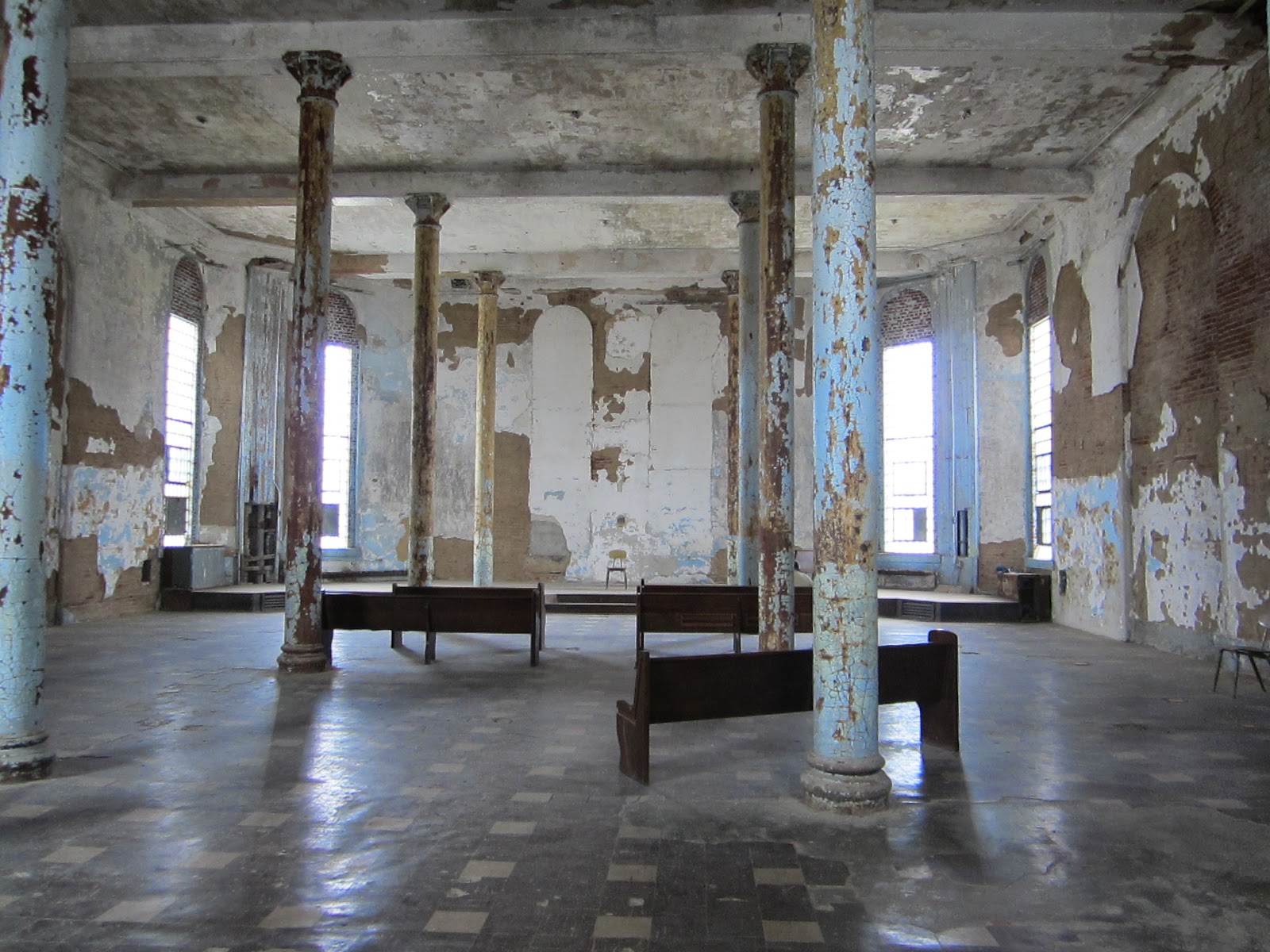
Above is the reformatorys chapel where Sunday church services were held for inmates. A large elevator in the back of the room was used to move prisoners from the cell block area to attend services. Im sure that in the day this was a bright and cheerful space.

This area was last used as a library.
Here is an old aerial photo showing the complex as it was in the mid-twentieth century.
 |
| Click to enlarge. |
As a regular law abiding Joe I dont give much thought to the idea of incarceration but spending a few hours in this collection of cages for men really slams home the reality of life for those who cant or have chosen not to conduct themselves to the standards of society. Its sad that today we still have to maintain modern versions of this kind of institution. Unfortunately as long as evil sometimes lurks in the hearts of men it will continue to be a necessity of our society.
Without a doubt one of Ohios most interesting even if a bit depressing historical sites.
Additional information at the OSR wikipedia entry.
Ohio State Reformatory